3. Accounts and balances
The previous chapter separated chain state from wallet state. This chapter explains what the wallet is counting. When you later send 1 ZEC, you should be able to predict which account and pool will change, and why a displayed total is not always spendable.
An account is a wallet identity
The app initializes six deterministic wallet accounts from one disposable seed:
- Accounts 1–5 are development accounts.
- Account 6 is a hidden treasury used for mining rewards and faucet payments.
The accounts API, Wallet page, account selector, and user-facing balances expose only 1–5.
Each user account has a transparent address and a unified address. For the flows in this book, selecting the Transparent destination pool uses the transparent address; selecting Ironwood uses the unified address for a shielded output. The server derives both from the instance’s seed.
That seed is fixed: the server builds it from 32 zero bytes, which makes
the mnemonic the well-known abandon abandon … art phrase. Every instance,
on every machine, therefore derives the same six accounts and the same
addresses.
A different instance name gives you a different chain and different balances; it does not give you different keys.
Use ths wallet balances or GET /api/v1/accounts to read the five addresses
for the instance you are using.
In the dashboard, select a Wallet account’s name to inspect and copy its full
unified and transparent addresses. Its stable page is /wallet/accounts/1
through /wallet/accounts/5. The page also offers the unified full viewing key
when the server includes it; it never shows spending keys. Searching a known
local unified address in Explorer reaches this same account page. That is a
wallet identity lookup, not a public history lookup for a shielded address.
Say that plainly: these keys are public knowledge. Anyone who has read this project can derive every address and every spending key your instance uses. That is fine, because it is what makes the environment disposable and reproducible — and it is exactly why nothing of value may ever touch these addresses. Never send real ZEC to an address shown by this environment.
A pool is a way value is represented and spent, not a separate wallet. Transparent value lives in unspent transaction outputs, or UTXOs; their addresses and amounts are public chain data. Ironwood value lives in shielded notes. The wallet learns which notes belong to it by scanning compact blocks; the public explorer cannot identify their recipient or read a memo.
This Regtest chain activates NU6.3 at height 1, and NU7 at height 1 unless the
instance was started with --nu7-height. The API offers transparent and
Ironwood pools; it rejects orchard because Orchard no longer accepts deposits
under NU6.3. Ironwood is this chain’s shielded pool;
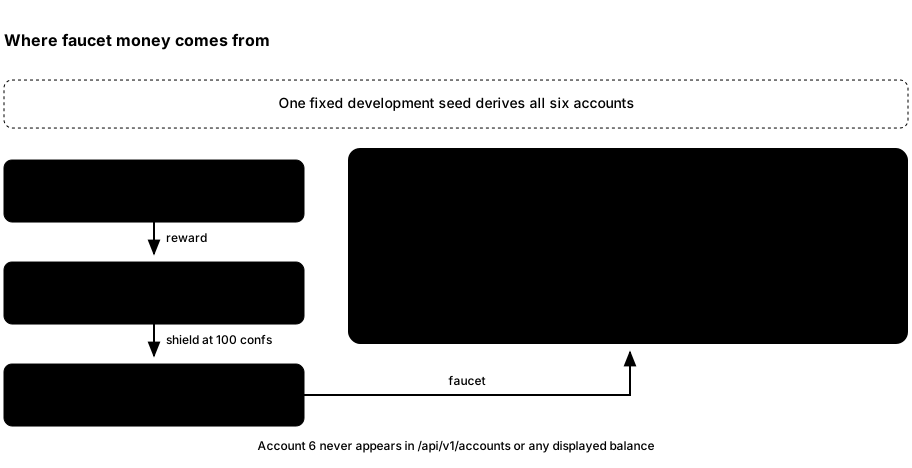
- Each user account can hold a transparent balance and an Ironwood balance. These are separate sources of funds, even though the dashboard also shows their sum.
- The miner sends block rewards to Account 6’s transparent address. Account 6 never appears in a user account list or balance total.
- The faucet can spend from Account 6 to a chosen user account and pool. A send between users spends the selected source account and pool and pays to the selected destination account and pool. The accounts may match when the pools differ; same-account/same-pool sends are rejected. An Ironwood send uses only Ironwood inputs; Sapling or legacy Orchard funds cannot cover a shortfall in the selected source pool.
ZEC, zatoshi, and spendability
ZEC is the amount unit you enter in the UI and CLI.
Zatoshi is the integer unit used by the API: 1 ZEC = 100,000,000 zatoshi (10⁸).
For example, 0.5 ZEC is 50000000 zatoshi. Use integer zatoshi in JSON
requests so a decimal floating-point calculation does not choose the wrong
amount.
The accounts API returns transparent_zatoshi and ironwood_zatoshi for
each user account. These are the server’s last reconciled wallet
snapshot, not numbers reconstructed from the block explorer. The dashboard
derives its displayed total from those fields.
A balance is not a promise that the next transaction can spend every zatoshi. The wallet SDK selects actual outputs or notes, requires a sufficient scan, and accounts for the transaction fee. Pending change and immature mining rewards can also affect spendability. Change is the unspent remainder of a selected input returned to the wallet; it may not be ready to spend immediately. The current send strategy routes change into the source account’s Ironwood pool, including change from transparent inputs.
You do not have to guess how much room the fee needs. POST /api/v1/send/quote
builds a dry-run proposal for one account and pool pair. It returns
available_zatoshi, fee_zatoshi, and max_zatoshi for the current wallet
state:
$ DASHBOARD_URL="$(ths endpoints --json | python3 -c 'import json,sys; print(json.load(sys.stdin)["dashboard"])')"
$ curl -fsS "$DASHBOARD_URL/api/v1/send/quote" -H 'content-type: application/json' \
    --data '{"from_account":1,"source_pool":"ironwood","destination_pool":"ironwood"}'
available_zatoshireports the funds available for one send before fees,fee_zatoshireports its fee,- and
max_zatoshireports the quoted maximum send amount.
A transparent send can use at most 1,333 eligible inputs. If an account holds
more, the quote’s available_zatoshi can be lower than its full transparent
balance in GET /api/v1/accounts. Max uses the amount that fits in one
send after fees; the account balance is unchanged.
From a terminal, ths wallet quote --from 1 --source-pool ironwood --destination-pool ironwood asks for the same quote and prints it in ZEC, or
in zatoshi with --json; see the
CLI reference.
These values depend on the selected inputs and current wallet state; a quote
does not reserve funds or guarantee a later send succeeds. Compare an intended
amount against max_zatoshi rather than the displayed balance. When a send
fails anyway, check the source pool and inspect wallet sync status before
trying again.
At the end of startup, Account 1 has 5 Ironwood ZEC. Account 2 starts empty. In the next chapter, we will give Account 2 transparent funds and then send it Ironwood funds from Account 1. That will make the two balances visibly different.
Where faucet funds come from
A faucet request does not mint coins directly into the destination. The miner first pays rewards to the hidden treasury’s transparent address. The reward created by mining a block is called coinbase; it must mature before it can be spent. When the treasury’s spendable Ironwood funds are insufficient, the server discovers needed mature rewards, shields them into the treasury’s Ironwood pool, confirms that shielding transaction, and retries the faucet payment. This can move the node height by more than the one block used to confirm the final faucet payment.
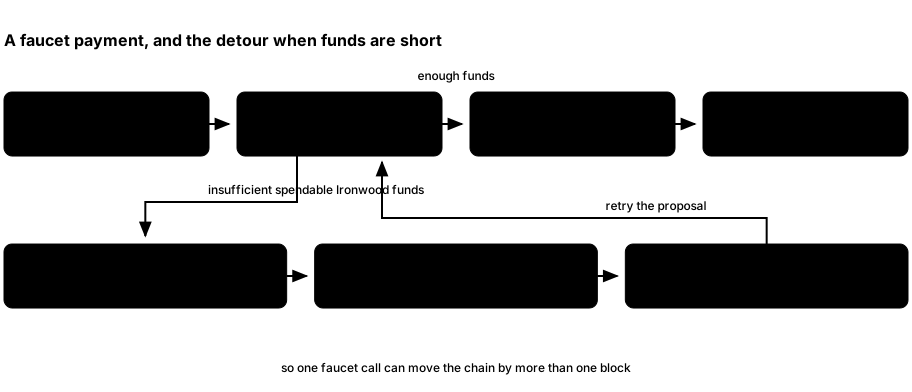
- Zakura mines to Account 6’s transparent address. The rewards are not user-account balances.
- The server durably claims the request before asking the wallet SDK to prepare the treasury payment. On insufficient spendable Ironwood funds, it advances the chain as needed for reward maturity, discovers the required reward output, and shields it to Account 6’s Ironwood funds. It retries the payment proposal.
- The wallet and server save the prepared transaction bytes before the server broadcasts to the chosen user account and destination pool. It normally mines a confirming block. Each account faucet request is limited to 5 ZEC.
Routine user wallet synchronization does not query all treasury transparent outputs. Treasury discovery runs when replenishment needs it. The private details stay out of the user account list, but the public chain may still show transparent mining rewards and shielding value movement.
Three views of the same experiment
After a payment, these views can temporarily disagree without being contradictory:
| View | What it can establish |
|---|---|
| Network or Zakura RPC | Which block is the current node tip. |
| Recent activity | Which request and transaction ID the server recorded, and whether it has a confirming block hash. |
| Wallet account balance | What the server’s reconciled wallet scan says the user account holds. |
Confirmed activity can precede wallet settlement because confirmation checks and wallet synchronization run independently. Keep using the accounts snapshot for balances.
Read Chapter 5 for the precise order in which those views catch up. The architecture chapter maps each view to its owner.